A summary isn't enough.
Target safety assessment (TSA) runs on weight of evidence. Scientists pull together clinical trial data, human genetics, biological mechanisms, animal models, protein expression and literature. Each source contributes a different part of the safety picture, and no single source is decisive. Bringing those signals together helps teams understand potential risks as a target progresses, whether to inform investment decisions, investigate those risks in the context of a patient population, or develop strategies to mitigate them.
Sable's Target Safety Intelligence platform brings this evidence together into an interactive report, which scientists can inspect and interrogate as they carry out a target safety assessment. Each report contains structured evidence from across these different domains, providing a common basis from which scientists can form their own view of a target. As the underlying evidence evolves, the report can be updated to reflect the latest information about the target.
With hundreds of pieces of evidence spread across several domains, however, working out where to focus can be difficult. We initially used LLMs to generate prose summaries for individual sections, giving scientists a quick overview before they explored the underlying evidence in depth. We also introduced Key Findings, which used LLMs to surface important information from across the report for scientists to review, edit or remove.
This made large reports easier to navigate, but the relationship between the generated text and its underlying evidence was not always easy to inspect. A prose summary could bring several signals together without making it immediately clear which evidence supported each statement, while Key Findings did not carry their supporting references directly. The two were also generated independently of each other, so the information surfaced within a section did not form part of the process used to determine what was surfaced at the report level.
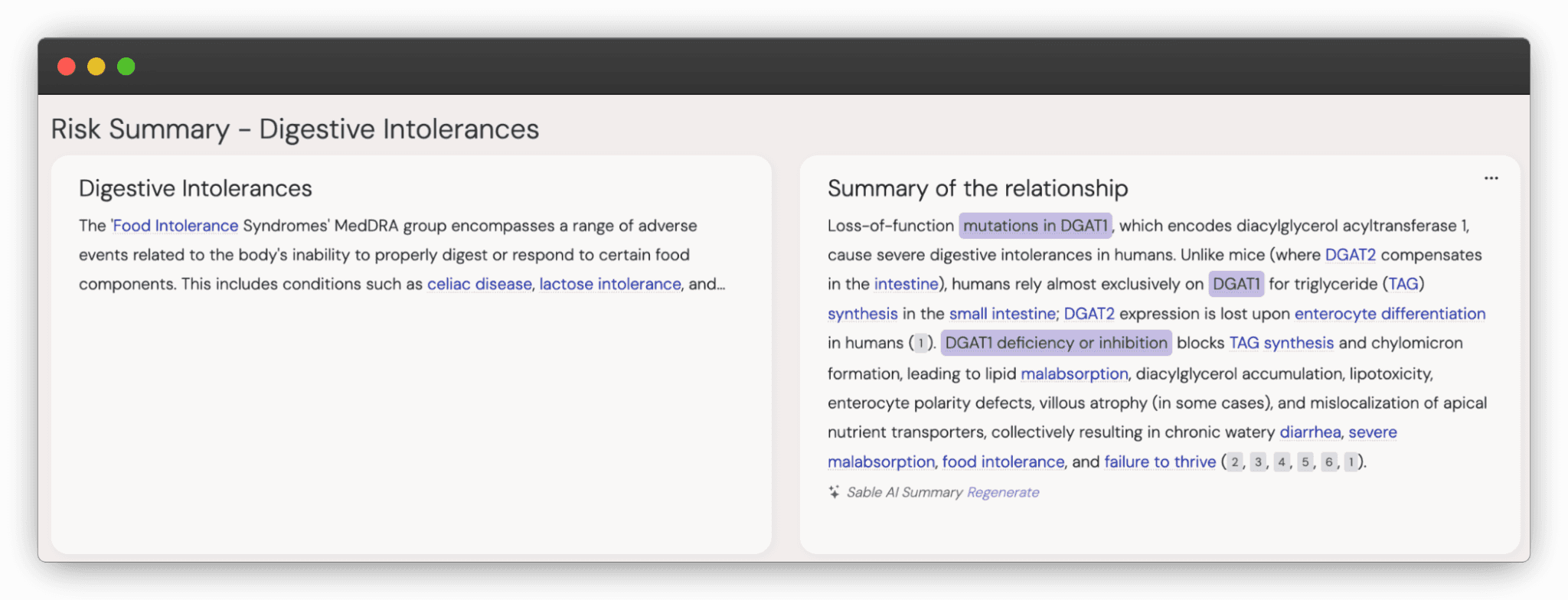
Figure 1: Legacy prose summary for the Digestive Intolerances risk cluster in a DGAT1 inhibition Target Safety Assessment.
We wanted to preserve the useful part of the existing experience, helping scientists to identify relevant information within a section and across the full report, while making the relationship between generated text and source evidence much easier to follow. Rather than representing a section as a paragraph, individual statements could carry their supporting evidence directly and provide a structured basis for what was surfaced at the report level.
What began as a change to our summaries therefore became a change to how generated information moves through a report.
From evidence to observations to findings
We called the new layer Evidence Observations: short, individually referenced statements that surface information within a defined set of evidence. An observation might describe an association within a group of related phenotypes, a pattern seen in mouse knockout evidence, or a safety signal reported in the clinical evidence available for a target. Several pieces of evidence can support one observation, but the observation stops short of making an overall assessment of what that evidence means for the safety of the target.

Figure 2: Evidence Observations for the same Digestive Intolerances risk cluster.
References are part of an Evidence Observation from the point at which it is generated. Alongside each statement, the LLM workflow records the identifiers of the evidence used to support it, allowing us to validate those references and preserve the connection as the information moves through the rest of the report.
Individual Evidence Observations are deliberately narrow, each describing information within a defined part of the report. Related information may also appear across different evidence types. For example, a phenotype described in mouse knockout evidence may have related evidence in human genetics or clinical data. Key Findings help surface these connections by bringing together related Evidence Observations from across the report, while preserving the individual observations and their supporting evidence for scientists to inspect.
The resulting hierarchy looks like this:
Primary sources → structured target evidence → Evidence Observations → Key Findings
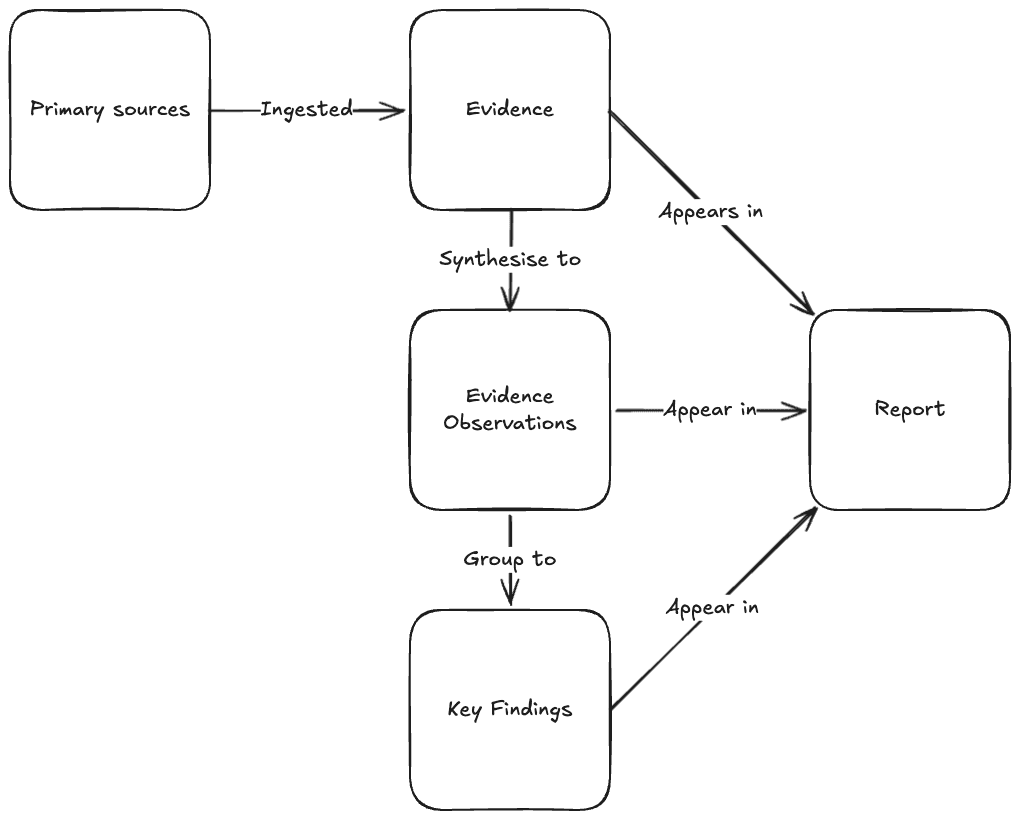
Figure 3: How primary evidence flows through the platform into Evidence Observations and Key Findings, while remaining available in the report.
Scientists can move from a Key Finding through its supporting Evidence Observations to the underlying evidence. The hierarchy helps surface connections across the report without replacing the scientist's role in deciding what those connections mean for the target.
Keeping the workflow constrained
With Evidence Observations and Key Findings forming part of the report itself, we needed the generation process to handle evidence consistently across reports.
By the time Evidence Observations are generated, Sable has already assembled and structured the evidence about the target. LLMs operate on top of that data rather than searching for evidence themselves, and the evidence provided for each generation step is scoped to its purpose. Clinical Evidence Observations, for example, are generated from the relevant clinical evidence, while Key Findings are generated from Evidence Observations rather than by going back through all of the underlying evidence again.
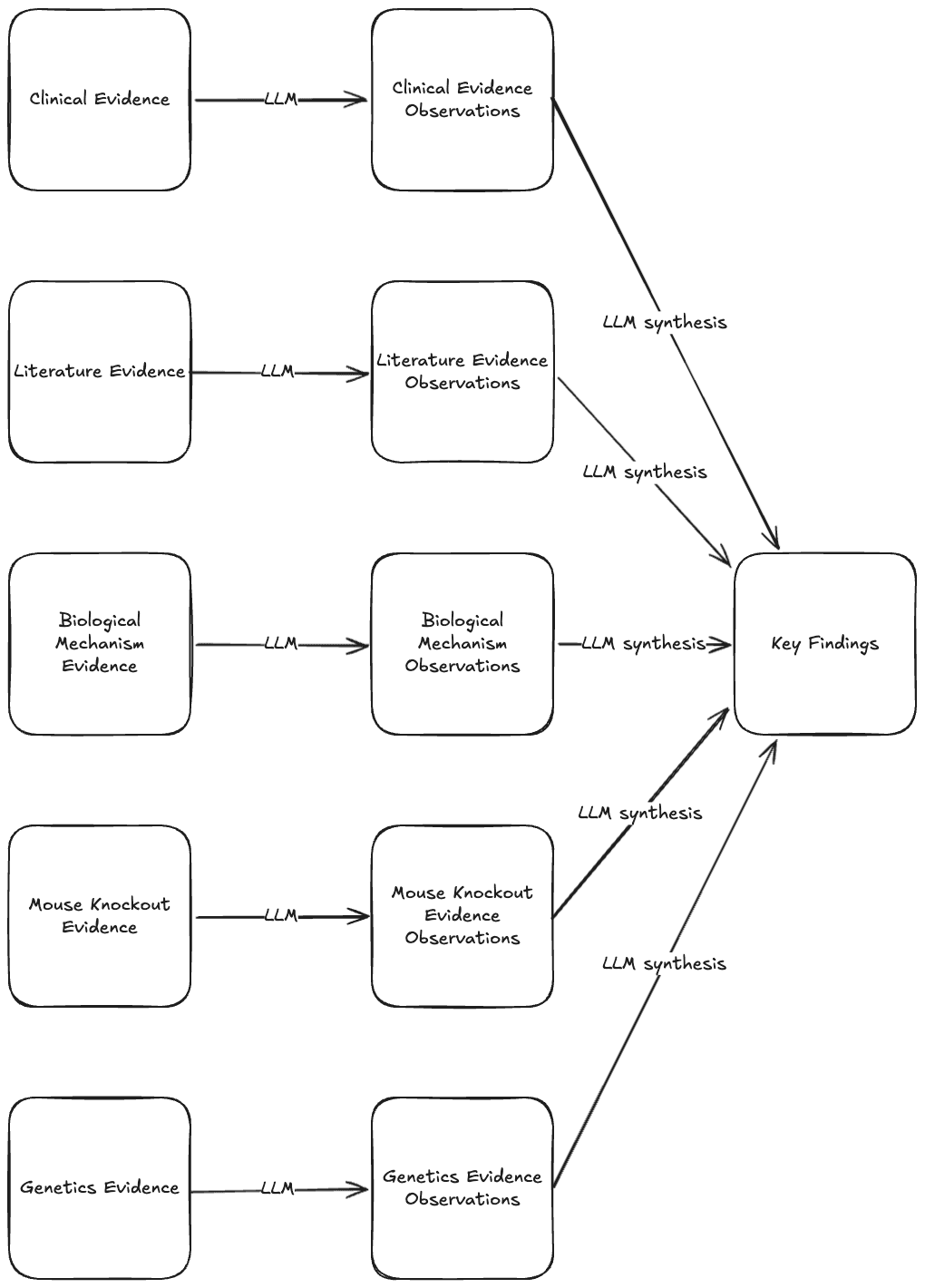
Figure 4: Evidence Observations are generated within individual evidence domains before being synthesised into Key Findings.
Some of the boundaries around generation are enforced in code. Every citation on an Evidence Observation is checked against the evidence supplied for that generation step, and generated content has to match a defined structure before it can be persisted. Generating no Evidence Observations is also a valid outcome when the supplied evidence does not support one.
Other boundaries concern what the generated content is allowed to say. Evidence Observations can describe the supplied evidence and relationships within it, but should not turn that information into an overall assessment of target safety. Some parts of the report do not require an LLM at all. Expression Observations, for example, are produced deterministically from structured expression data because presenting that information doesn't require language understanding.
The sequence connecting these stages is fixed as well. LLMs don't decide which part of a report to process next, whether to skip a stage, or whether enough evidence has been considered. Each report follows the same defined sequence from structured evidence, through Evidence Observations, to Key Findings.
We could instead give an agent access to the available evidence and allow it to choose what to investigate next, but that would solve a different problem. Scientists researching a target already encounter a similar rabbit-hole effect, where the paper read first or a particular signal that attracts attention can influence which questions they investigate next. Following those threads is valuable when exploring a particular question, but for the baseline report we want each target to pass through the same defined process.
Sable's Chat with Report provides that more open-ended form of exploration, allowing scientists to investigate a particular question or follow an unusual signal within the context of an existing report.
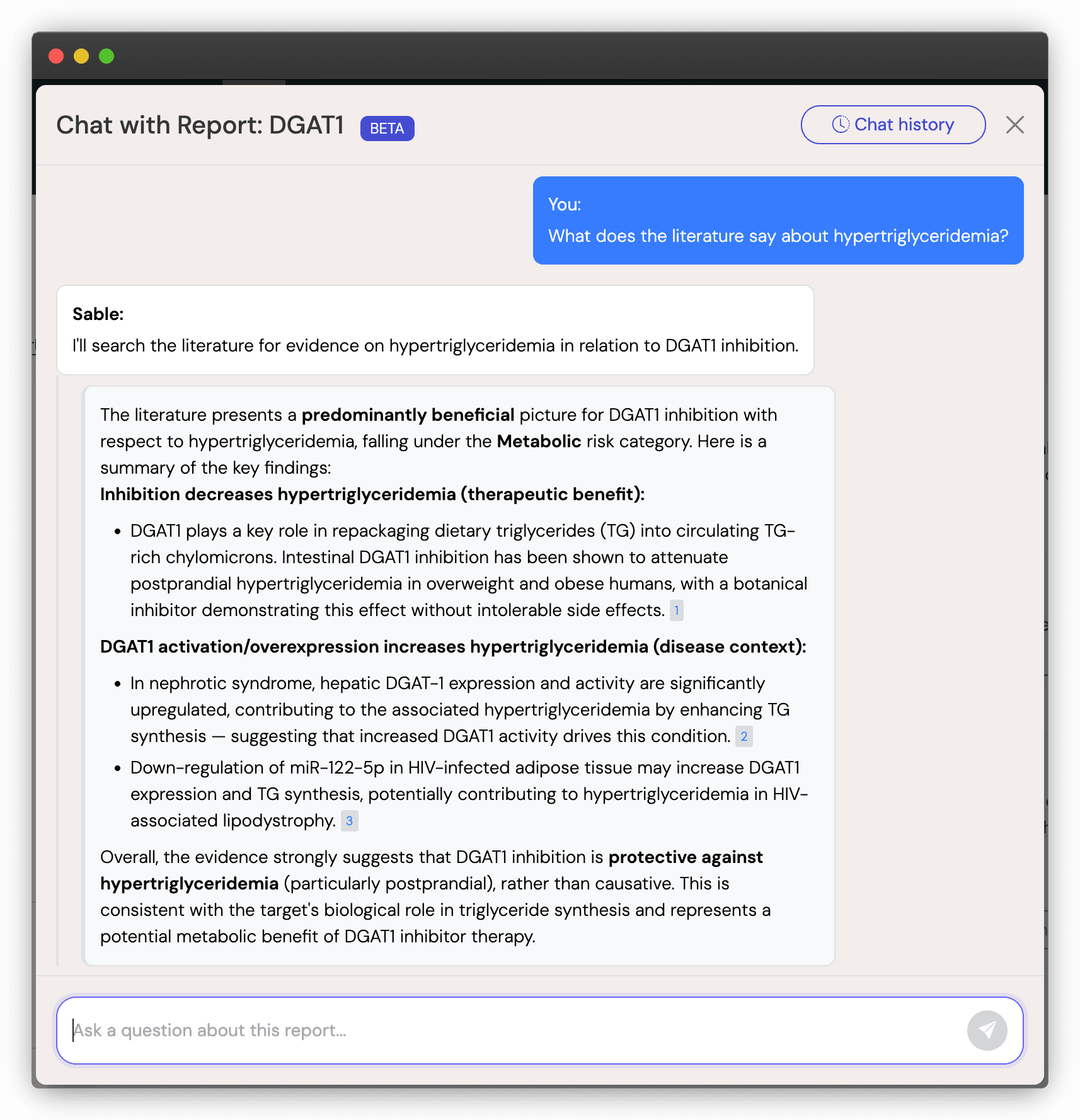
Figure 5: Chat with Report exploring hypertriglyceridaemia in the context of DGAT1 inhibition at the user's request.
Exploration benefits from being able to change direction and follow a rabbit hole when required. The baseline report benefits from predictable coverage, provenance and repeatability. Rather than asking one interaction model to solve both problems, we use a fixed workflow to construct the common evidence foundation and allow more autonomous exploration on top of it.
What happens when the evidence changes
Persisting Evidence Observations and Key Findings as part of a report introduces another consideration: the evidence underneath them can change after they have been generated. New research becomes available as our underlying evidence sources are updated, and scientists can also curate a report themselves by excluding evidence they don't consider relevant. As the evidence included in a report changes, generated content that accurately reflected the evidence when it was created may no longer reflect what is currently included.
To account for this, we track whether generated content has become stale as the report changes. If a scientist removes evidence that was used to support an Evidence Observation, for example, we can identify that the observation may no longer reflect the evidence currently included in the report. Key Findings retain their links to the Evidence Observations underneath them, so we can also identify when a finding depends on an observation whose supporting evidence has changed.
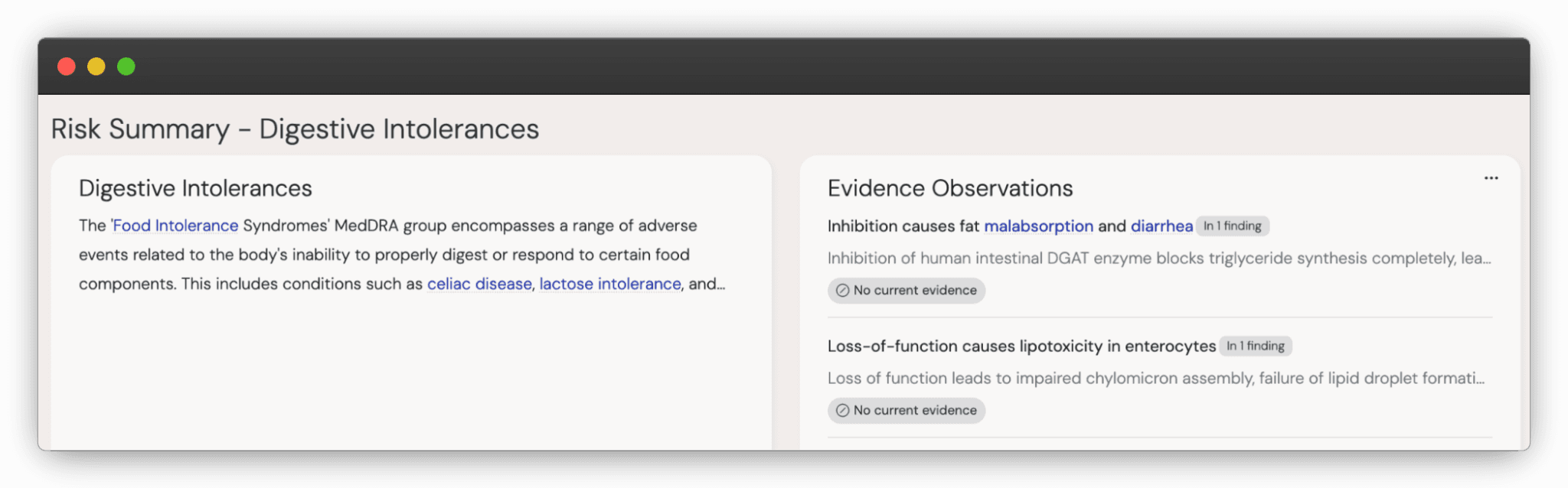
Figure 6: Evidence Observations for the Digestive Intolerances risk cluster after the Malabsorption phenotype is dismissed. The affected observations are automatically marked as having "No current evidence".
Provenance therefore needs to capture more than where a generated statement came from. For content that persists alongside a changing report, we also need to preserve enough of its relationship with the underlying evidence to recognise when the context in which it was generated has changed.
Keeping scientists in control
These workflows are newly in production, so our evaluation of their impact is still early. Initial feedback from customer scientists and Sable's own scientific team has favoured Evidence Observations and the new Key Findings over the prose summaries they replaced.
The purpose of these generated layers is not to make the target safety assessment on the scientist's behalf. Scientists can inspect the evidence behind what has been surfaced, edit or remove generated content, and bring their own knowledge and context to the assessment. The workflow helps organise information across a large body of evidence while leaving decisions about its significance with the people carrying out the assessment.
Building this experience has made us more deliberate about where we use LLMs and what we keep outside them. Generated content is persisted because it is useful beyond a single interaction, but that also means preserving its provenance, recognising when the evidence underneath it changes, and controlling how it is used by subsequent stages of generation.
Using LLMs more deeply within a scientific product therefore hasn't meant giving them more control over the scientific process. For a baseline target safety report, we have found it more useful to constrain generation within a predictable flow of evidence, preserve what is generated as part of the report, and give scientists a clear path back to the sources underneath it.
